Brown Eye Medical Clinic · Eyelid Surgery, Stem Cell Lifting & LSSA Liposuction in Seocho-gu, Seoul
5.0 Patient Satisfaction · Est. 2000
en-US

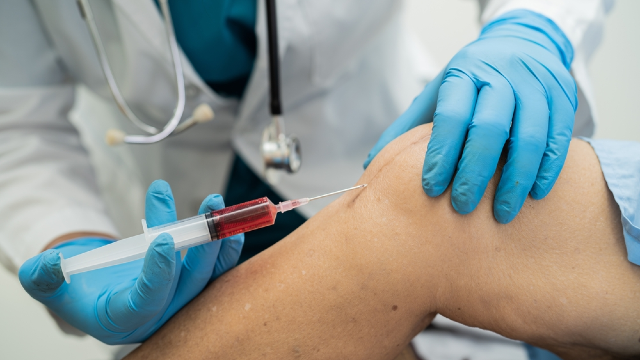
Medical Guide
Stem Cell Joint Therapy: Can It Help Knee and Shoulder Pain?
What Browneye claims for joint injections is support for comfort and flexibility, not repair. Why that wording matters, and what the FDA tells patients.
Schedule a ConsultationStem Cell Joint Therapy: Can It Help Knee and Shoulder Pain?
Medically reviewed by Dr. Hansen Lee, MD, PhD, Plastic Surgery Specialist, Browneye Plastic Surgery
Of everything sold under the regenerative heading, joint injections have attracted the loudest claims and the most regulatory attention. A patient researching knees or shoulders meets language that would be unusual anywhere else in medicine.
Against that background, what Browneye Plastic Surgery publishes is comparatively restrained, and the restraint is the most useful thing about it.
The clinic describes Scalp or Joint Rejuvenation as a regenerative treatment designed to support tissue health in the scalp or joints by encouraging the body's natural repair mechanisms rather than replacing or surgically altering tissue. For joints, the stated aims are supporting joint tissue recovery, improving joint comfort and flexibility, and promoting long-term tissue vitality — with improvements developing gradually and varying by individual tissue condition, overall health and lifestyle.
Note what is absent. No claim to rebuild cartilage. No claim to treat arthritis. No claim to replace surgery. This article stays inside that boundary and explains why the boundary is where it is.
Support, comfort, flexibility — and what those words leave out
Three of the clinic's four stated joint aims are about how a joint feels and moves: comfort, flexibility, stiffness. The fourth, tissue recovery, is about process rather than outcome.
That matters because a joint problem has at least three layers, and they do not move together:
Symptoms — pain, stiffness, how far it bends. What the treatment's stated aims are about.
Structure — the state of cartilage, tendon and bone. Nothing in the clinic's published claims addresses this.
Cause — why the joint got that way, which determines what else should happen.
A patient whose knee hurts wants all three. A treatment aimed at the first is not thereby aimed at the other two, and a clinic that says so plainly is being accurate rather than modest.
Knee injuries and disorders and shoulder injuries and disorders cover how many distinct problems live under "my knee hurts" and "my shoulder hurts". Osteoarthritis covers the one most people assume they have.
Who the clinic says it suits
Individuals in their 30s to 60s experiencing joint stiffness or reduced flexibility, or seeking a regenerative approach that supports natural tissue repair instead of surgery. The scalp indications sit in the same list, since the clinic treats these as one service.
Two observations.
The named findings are stiffness and flexibility, not pain. Pain appears in the benefit list as "joint comfort" but not in the candidacy list, and that is a meaningful difference. If severe pain is your main complaint, you are asking a question the candidacy language does not directly answer.
No condition is named. Not arthritis, not a tear, not an injury. The language describes states rather than diagnoses, which makes your diagnosis the missing piece. Pain covers the general subject, including why persistent joint pain deserves a diagnosis rather than a treatment.
What the FDA tells patients about this specific area
This is the part to read before the clinic's material rather than after it.
Joints are where regenerative marketing has been most aggressive internationally, and the US regulator publishes consumer-facing material precisely because patients were being offered products whose claims outran their evidence. Read its alert for consumers on these products first; its page for patients considering a regenerative therapy covers what to establish before agreeing. Neither is about this clinic, and neither should be read as one. They are about the category, and a patient who has read them asks sharper questions of whoever they end up seeing — in Seoul or at home. Stem cells covers the underlying biology, and evaluating health information covers how to weigh a claim that sounds impressive.
A simple test to carry into any consultation: ask what the treatment is expected to change, and in what time frame, and what would show it had not worked. A provider who answers those three in plain terms is describing a treatment. One who answers with the word regenerative is describing a category.
Why the knee and the shoulder are not one question
Patients group them because both are joints that hurt. Clinically they behave differently enough that an answer for one is not an answer for the other.
The knee carries you. It is a weight-bearing joint, which means every step tests whatever is wrong with it and recovery competes with ordinary life. Stiffness in a knee is frequently about load as much as about tissue.
The shoulder does not carry you; it reaches. It trades stability for range, and its problems are more often about the soft tissue around the joint than about the surfaces inside it. A shoulder that will not lift above the head and a knee that aches on stairs are different stories with different likely causes.
Knee injuries and disorders and shoulder injuries and disorders set out how many distinct conditions sit behind each complaint.
The practical consequence for a consultation is simple: say which joint, say what movement is limited, and say when it started. A treatment described as supporting tissue recovery is being aimed at something, and that something should be named before the needle is.
Questions to settle about the injection itself
Four items that a patient is entitled to have answered plainly for any joint injection, anywhere.
What is being injected, and where did it come from? This is the first question the FDA's consumer material trains patients to ask, and it is the one that most often goes unasked.
Is the injection guided? Joint injections may be placed by landmark or under imaging. Which one applies to you, and why, is a reasonable question.
Who performs it? Named, in writing, before travel.
What happens afterward, and when do I know? A date for the assessment rather than a vague horizon.
A clinic that answers those four specifically has given you something checkable. Write the answers down — talking with your doctor covers keeping the exchange concrete, and across a border it is also your only record.
The published sequence
The clinic sets the service out in five stages. It opens with an assessment, from which a plan specific to the patient is drawn up. The injections follow, placed into the joint area identified in that assessment. Aftercare instructions are given immediately afterward, and the sequence closes with an evaluation visit at which further sessions may be recommended according to how the patient has responded.
The published consultation description for this service includes a target-area examination, in which the affected joint is assessed to identify the underlying concern, alongside a review of medical conditions, medications, allergies and previous treatments.
For an overseas patient, step five is the planning problem: the number of sessions is not fixed in advance, so the shape of the course has to be agreed in writing before you book anything.
Risk, recovery and aftercare as published
This profile is the one regenerative entry at the clinic that publishes a risk statement, and it is worth quoting as it stands: temporary redness, mild swelling, minor discomfort at injection sites and temporary sensitivity may occur; serious complications are uncommon but can occur with any injection procedure; patients should follow post-treatment instructions and attend follow-up appointments.
Recovery, as published: temporary swelling or sensitivity immediately after treatment, generally resolving as treated tissues recover, with regenerative improvements occurring gradually over time.
Preparation, as published: consultation, medical assessment, health-history review, evaluation of the joint condition, and a personalized plan before treatment proceeds.
Aftercare, as published: instructions to support tissue recovery, and scheduled follow-up visits so the physician can monitor the response and decide whether additional sessions are appropriate.
What is not published for this service is an exclusion list or an anesthesia method. Both are consultation questions.
One item belongs in your own planning regardless: what you may and may not do with the joint afterward, as a date rather than a feeling. A treated knee that feels better is not evidence that it is ready for what made it sore, and the instruction should come from the clinician rather than from how the morning went.
Infection control covers the signs that mean something is wrong — spreading redness, warmth, discharge, fever, or pain climbing rather than settling — and a joint is an area where those warrant a same-day call rather than a wait.
What this does not replace
Three things, stated plainly.
It does not replace a diagnosis. If nobody has established why the joint is stiff, a supportive injection is being added to an unknown.
If you are traveling for this
Three practical points, because a joint course is a poor fit for a single trip.
More Articles
Continue reading our clinical guides and insights.
Relieve Knee and Hip Pain with Stem Cell Therapy
Relieve knee and hip pain with advanced stem cell therapy. Discover a non-surgical option to reduce inflammation and restore mobility—book a consultation today!
Learn More

Achieve Firmer, Younger Skin Without Surgery
Achieve firmer, younger-looking skin without surgery using non-invasive treatments. Restore your glow and confidence—explore your options today!
Learn More

How Eyelid Surgery Can Help You Look Less Tired
Discover how eyelid surgery can help you look less tired by reducing puffiness and sagging. Refresh your appearance—schedule a consultation today!
Learn More